
We get it. AI is everywhere. Hype or not, businesses would’ve been stupid not to lean into it to enhance their proposition. Their customers have been wooed by it and their investors have backed it. But are we starting to see an end to AI being the focal point? Even if the hype materialises, is what appears an exciting and unique technology today becoming an expected commodity tomorrow? Can businesses that have relied on it to sell and raise money assume the trend will continue? Or is the rise of the AI based proposition running its course?
The rise of the AI proposition
You’re lying if you told me you haven’t heard, seen, or been beaten over the head with something about AI in the past 24 hours (sorry, I promise this isn’t another article on how AI is taking your job). My parents were talking about it at the dinner table over the weekend, Boris is emphasising the ‘A’ and the ‘I’ like they’re two of Elons kids and most people, including myself, have no real idea what’s hot air vs having the potential to drive an internet scale shift in society. Whatever your view, good, bad, ugly, awe-inspiring, the bottom line is, it’s everywhere.
So, if you’re not ‘doing’ something with AI (or at least be seen and say you are), at best you’ll be told you’re falling behind by every commentator on LinkedIn and at worst, lose your job. Only 8 years ago, just 4% of global CIOs reported using AI. Fast-forward to today, where 78% of global businesses anticipate increasing their AI spend and 80% of global businesses now report using generative AI in at least one business function, up from 55% a year earlier. Worldwide spending on AI is expected to total nearly $1.5 trillion for 2025 according to Gartner, investment that makes the .com bubble look tame.
That is one big wave (or bubble, depending on who you listen to) and you don’t have to be doomscrolling points of view on the singularity to see the impact. Just look at LinkedIn. Start-ups, scale-ups, and divisions of incumbents have sprinted to slap “AI-powered,” “AI-native,” or “AI-enabled” (for the rest of this article referred to as “AI-Somethings”) onto every proposition and sales pitch deck. And why wouldn’t they? This wave is there to ride. An opportunity for businesses to exploit. If you’re building a B2B tech business today, “AI Something” is a calling card. As a TechStars’ 2024 survey highlights, 74% of entrepreneurs say AI is a component or enabler of their startups, with many founders now betting their entire value proposition on using AI effectively and global counts of AI based companies have soared past 70,000. Even more enticing for start-ups is it’s been a funding fountain. Today, AI is driving over 70% of today’s funding rounds. If you are not an “AI Something” business, good luck raising your Series A.
It’s pretty clear then, being “AI Something” is a differentiator today. It gets attention, press coverage, and investors leaning in. But what happens when it stops being a novelty?
Why ‘AI’ alone will not be a differentiator
Decision-makers aren’t blind, and buyers are increasingly challenging the real, lived value of AI businesses and their promises. Where AI doesn’t deliver, trust issues emerge. Where it does, it becomes table stakes. And in all cases, the sheer volume of AI products, messaging and commentary creates user/buyer fatigue. Suddenly, “powered by AI” is at risk of becoming background noise, not headline news.
Trust and confidence issues
Many AI initiatives struggle to achieve scale and even meet expectation. Even after huge investments, the results aren’t always there. Gartner’s 2024 survey finds 80% of tech buyers report some form of post-purchase regret as a result of information overload and a wave of promises that don’t pan out in reality. Those who put it to the test and start to scratch the surface realise it’s not the panacea. Errors and hallucinations undermine the magic. When your LMM struggles to count (true story on a number of occasions), perfect answers and outputs aren’t instantaneous and you start to realise how much work is required to properly prompt, people start to retreat. For example, take the generational sentiment toward AI in insurance. Insurity’s 2025 report shows confidence across generations is in decline. Gen Z is the only group holding steady (at a not-so-spectacular 25% positive sentiment), while Millennials plunged to 26% from 41% the year before, Gen X to 20% (from 34%), and Boomers at a mere 10% (from a low base of 13%). Scepticism about AI-driven processes is rising.
And it’s not just users. Investors are starting to call time on many AI wrappers as well. They’re looking beyond the hype and identifying swathes of copycat businesses that are simply repurposing existing models, failing to deliver any real benefit to customers beyond basic API calls and void of any form of competitive moat.
The fatigue is starting to show
With the pressure to be doing something and seize the opportunity, the volume of proof of concepts and testing of different AI tools has been significant. Not a bad approach, however, there are signs of fatigue. The share of companies that scrapped the majority of their AI initiatives jumped from 17% in 2024 to 42% so far this year, according to analysis from S&P Global Market Intelligence.
Users that apply AI tools to their working lives are potentially feeling it too. According to a study from Quantum Workplace, employees who consider themselves frequent AI users reported higher levels of burnout (45%) compared to those who infrequently (38%) or never (35%) use AI at work.
When there is so much noise, expectation and you are constantly being bombarded with messages about a single thing, it’s only human nature to get sick of hearing about it.
Applications that work will become table stakes
If you look at history and apply the ‘Kano Model’, what appears to be a technological miracle, borderline magic today, becomes a basic need tomorrow. Think about sat navs in cars, colour TVs and even the internet. The biggest shifts start as innovations and quickly become expected features. Even the winners of today’s AI revolution, those that do cut through and are applied to our working and personal lives, will eventually be tomorrow’s plain vanilla.
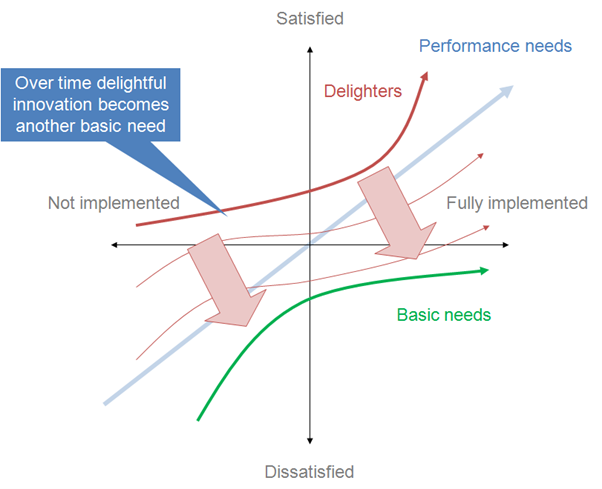
With these factors converging, commercial and product leaders in “AI-Somethings” face a new challenge. AI messaging won’t convert like it used to as we start to hit peak blindness for all things AI. So, if simply being AI is your “magic sauce” for differentiation, it’s time to take stock. Buyers, battered by hype, crave relevance and tangible business benefit. If commercial leaders aren’t sharpening their value proposition, there’s a risk of being overtaken as soon as AI shifts from must-have to must-include.
Evolving the proposition for your “AI something ”
“AI-Somethings” will need to pivot from technology-driven positioning to focusing on what customers genuinely value. The technology is and should only ever be an enabler to solve the real challenge.
No matter how complex or revolutionary your AI, the fundamentals of a great offer and business remain as old as time. Does your product solve a specific, valuable problem for a market hungry for a solution? That’s the foundation for any strong startup, scale-up or division of a corporation. Investors, while still betting big on AI, are now scrutinising real use cases, defensibility, and customer impact. “Our product is AI-XX” isn’t enough. Instead “Here’s how we solve your toughest challenge.” is where the conversion needs to start.
However, it would be foolish to shelve your AI positioning altogether. Especially right now when the AI wave is still rolling. The critical move is to show, not tell. Demonstrate how your work solves problems better, more efficiently, or more reliably than alternatives and how the development or unique application of AI supports this. Technology as the supporting act not the lead.
GoDaddy look beyond their tech
GoDaddy have hit the nail on the head with their recent proposition for GoDaddyAiro. No, not just because they found a clever way of including AI in the name without it being GoDaddy.AI. It’s the orientation around a real SME leader truth rather than the AI capabilities they have.
SME PROBLEM – I need a website, logo, etc but truth is, I don’t really know what I’m doing.
GODADDY SOLUTION – A website builder that’s less frustrating than the other website builders and cheaper than an agency…GoDaddy Airo
TAG LINE – “It’s like you know what you’re doing”
Not only does it speak to a deeper truth SME business owners have (I can vouch for that), it’s crucially not “GodaddyAI the website builder that uses AI to develop your website in seconds”. In fact, AI isn’t really the central point at all. Instead, it’s just the explanation as to why it can deliver the benefit it claims.
So, if we are at a turning point, and there is a need to be more GoDaddy than GoAI! what should commercial leaders in start-ups, scale-ups and incumbents do to get ahead of the vast number of AI somethings?
Actionable steps for commercial leaders
Step 1- Audit your messaging: Do you lead with customer need or lead with cool AI tech? And do you know if it’s relevant to your target customers and their opportunities, not just a demonstration of your technology? If you don’t know, find out by asking existing customers, customers you’ve lost or missed out on and potential customers, you’d love to work with. How? Take a look at The most important part is the customer
Step 2 – Rethink your value proposition: Start with customer problems, market dynamics, and pain points. Then (and only then), evaluate what slices of your AI capability genuinely help meet those needs. Resist the temptation to highlight every shiny algorithm and feature. For help approaching this step: Perfect Proposition – Compelling, unique, true
Step 3 – Identify development priorities that strengthen value: Stop chasing the next hot feature unless it boosts your proposition. Build, acquire, or partner for capability only where it shores up real competitive advantage or delivers a customer benefit.
Step 4 – Coordinate across teams: This isn’t an endeavour to go alone as a commercial leader or function. Work with tech, product, compliance, ops to work it out and develop a proposition that is compelling to your target audience, utilises what you’re good at and is distinctive from your competitors.
Challenge or opportunity
If you’re a commercial leader at a scaling AI B2B firm or at a large company, responsible for your new AI product, you’re facing a moment of inflexion. The AI boom isn’t going away, but its novelty is fading. The window for differentiation based on “AI” alone is closing, fast.
The opportunity? Get ahead of the shift. Build propositions that directly tap into the challenges and needs customers care about most. Your ability to win will be on relevance and results you deliver with AI being a key ingredient but not the sole focus. You’ll thank yourself later, when all the “AI-something’s” decide to play catch-up.
If you’d like to chat through developing your propositions to get ahead and create more value for your customers, contact the team here.